
Resolved No Matter What

Leadership Lessons From Abraham Lincoln
"But Daniel purposed in his heart that he would not defile himself with the portion of the king's meat..." (Daniel 1:8)
The Election Lincoln Was Willing To Lose
Leadership is often romanticized because we usually study it from the other side of history. We know how the story ends. We know who won the battle, who survived the crisis, and who ultimately emerged victorious. What we often forget is that great leaders rarely enjoy that luxury while they are living through their defining moments.
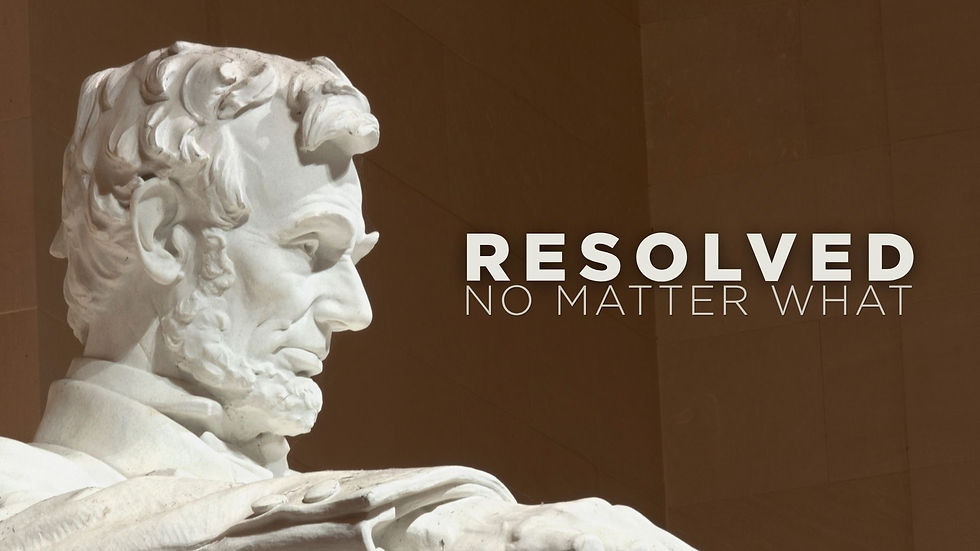
Abraham Lincoln faced one of those moments during the summer of 1864.
The Civil War had dragged into its fourth brutal year. The nation was exhausted. Hundreds of thousands of young men had died. Families throughout the North lived under a cloud of grief and uncertainty. Political opponents attacked Lincoln relentlessly, newspapers questioned his competence, and even members of his own party doubted whether he could win another election. The military situation seemed uncertain, public support was eroding, and many believed his presidency was nearing its end.
What made matters even more difficult was the growing chorus of voices urging compromise. There were influential leaders who believed the war could be brought to a close if Lincoln would simply remove emancipation from the discussion. If slavery were left intact, peace negotiations with the Confederacy might become possible. The bloodshed could end. The nation could begin healing. Lincoln's political future might even be secured.
From a political perspective, compromise seemed practical. From a moral perspective, Lincoln believed it was impossible.
He had come to view slavery not merely as a political issue but as a profound moral wrong. He understood that preserving the Union while preserving slavery would not solve America's greatest problem. It would merely postpone it. Consequently, Lincoln reached a decision that revealed the depth of his character. He would rather lose the presidency than abandon what he believed was right.
What is remarkable is that Lincoln made this decision before circumstances improved. Before General Sherman captured Atlanta. Before public opinion shifted. Before victory seemed likely. Long before history vindicated his position, Lincoln had already settled the matter in his conscience.
That is the essence of resolution.
The word resolved describes a matter that has already been decided. The debate is over. The conviction has been established. The course has been chosen.
That is precisely what we find in Daniel 1:8. As a young man living in Babylon, Daniel found himself under tremendous pressure to conform. Yet before the test fully unfolded, Scripture tells us that he "purposed in his heart." The battle was won internally before it was ever fought externally.
Every leader eventually encounters moments when conviction collides with convenience. There are seasons when compromise appears advantageous, when doing right becomes costly, and when obedience seems likely to result in loss. In those moments, leadership is revealed for what it truly is.
The question is never whether pressure will come. The question is whether the decision has already been made.
I. A Resolved Leader Settles His Convictions Before The Crisis Arrives
One of the greatest misconceptions about courage is that courageous people somehow manufacture bravery in the middle of a crisis. Scripture presents a different picture. Most acts of public courage are actually the result of private convictions that have been developed over many years.
Daniel's stand in Babylon did not begin when the king's food was placed before him. His courage began long before that moment. Somewhere in the quiet formation of his character, Daniel had already decided whom he would obey and what he would believe. The public decision simply revealed an inward commitment that already existed.
The same principle appears repeatedly throughout Scripture. Joseph's refusal of Potiphar's wife was not the product of a sudden burst of courage. It was the fruit of years spent walking with God. Joshua's declaration, "As for me and my house, we will serve the Lord," did not emerge from a moment of emotion. It reflected convictions that had been shaped over decades of faithfulness.
One reason many leaders struggle during times of pressure is because they attempt to make decisions in the crisis that should have been settled before the crisis arrived. When convictions remain undefined, every circumstance becomes negotiable. Every challenge creates uncertainty. Every opportunity presents another excuse to compromise.
Daniel understood that the time to establish convictions is before those convictions become costly. Lincoln understood the same principle. By the summer of 1864, he had already determined what mattered most. Therefore, when political pressure intensified, he was not deciding what was right. He was simply living according to convictions that had already been settled.
Great leaders are rarely made in moments of crisis. More often, crisis simply reveals the leaders they have already become.
II. A Resolved Leader Chooses Principle Over Popularity
One of the defining moments in every leader's life occurs when principle and popularity begin moving in opposite directions. As long as doing the right thing is applauded, leadership remains relatively easy. As long as conviction is rewarded, standing firm requires little courage. The true test comes when obedience threatens acceptance and integrity threatens advancement.
That was precisely Lincoln's dilemma.
The nation was tired of war. Citizens wanted peace. Political advisors wanted compromise. Newspapers demanded solutions. Public opinion was shifting. Everything around Lincoln suggested that abandoning his position on emancipation would improve his political future. Yet he understood something many leaders never learn: there are moments when preserving your integrity matters more than preserving your position.
The temptation to seek approval is not unique to politicians. It follows pastors, ministry leaders, business leaders, and parents alike. Every leader feels the pull of public opinion. We all prefer affirmation to criticism. We enjoy support more than opposition. Yet leadership often requires disappointing people in order to remain faithful to truth.
The Apostle Paul understood this tension when he wrote, "For do I now persuade men, or God?" Paul's ministry repeatedly placed him at odds with the culture around him because he refused to adjust truth to fit public preferences. Likewise, Daniel's commitment to God placed him at odds with Babylon. His convictions were not shaped by the expectations of his environment but by the authority of God.
One of the greatest dangers facing modern leaders is the temptation to measure success by acceptance. Social media has only amplified this tendency. Leaders can become addicted to approval and fearful of criticism. Yet history consistently demonstrates that transformational leaders are rarely those who follow the crowd. More often, they are those willing to stand against prevailing opinion because they are convinced that truth matters more than applause.
A.W. Tozer wisely observed, "A man who has God for his treasure has all things in One." Leaders who truly believe that discover a remarkable freedom. They are no longer controlled by criticism, nor intoxicated by praise. Their decisions are governed by conviction rather than popularity.
III. A Resolved Leader Accepts The Cost Of Obedience
Every meaningful conviction eventually demands a sacrifice.
This is where many leaders become discouraged because they mistakenly assume that obedience should make life easier. Yet throughout Scripture, obedience often makes life harder before it makes life better. Following God does not exempt us from difficulty. In many cases, it leads us directly into it.
Daniel's obedience eventually carried him into a lion's den. The three Hebrew men found themselves standing before a furnace because they refused to bow. Esther risked her life by entering the king's presence. Paul endured beatings, imprisonments, and rejection because he remained faithful to his calling.
Even our Lord's perfect obedience led Him to Calvary.
Lincoln's convictions carried a cost as well. His refusal to compromise threatened his presidency and potentially his legacy. He understood that doing what was right might result in losing the office he occupied. Yet he was willing to accept that possibility because he believed there were things more important than political success.
Modern leadership culture often celebrates results while ignoring sacrifice. We admire successful leaders without considering the difficult decisions that made their success possible. We enjoy the story after the victory but rarely appreciate the uncertainty that existed beforehand.
Resolved leaders understand that every worthwhile stand comes with a price tag. They understand that comfort is not the highest virtue and security is not the ultimate goal. Faithfulness is.
Jim Elliot famously wrote, "He is no fool who gives what he cannot keep to gain what he cannot lose." That perspective allows leaders to endure temporary losses because they understand that eternal values are worth protecting.
IV. A Resolved Leader Trusts God With The Outcome
One reason compromise often appears attractive is because leaders naturally want certainty. We want guarantees. We want assurance that doing the right thing will produce favorable results. We want confidence that our sacrifices will be rewarded according to our timetable.
God rarely provides such assurances.
When Lincoln stood firm in 1864, he did not know Sherman would capture Atlanta. He did not know public opinion would change. He did not know reelection would ultimately be secured. All he knew was what he believed to be right.
Daniel faced a similar reality. When he refused the king's provisions, he could not foresee how God would work. Esther did not know whether she would survive her audience with the king. The three Hebrew men openly admitted they did not know whether God would deliver them from the furnace.
What they did know was that God was worthy of obedience regardless of the outcome.
That distinction lies at the heart of mature leadership.
Too many leaders become consumed with outcomes they cannot control. They spend enormous energy attempting to manage results that ultimately belong to God. In the process, they become vulnerable to compromise because they fear what might happen if they remain faithful.
Resolved leaders think differently. They understand that obedience is their responsibility while outcomes belong to God. They focus on faithfulness rather than results. They ask, "What is right?" before asking, "Will this work?"
Such leaders discover a remarkable freedom. Once they have determined what obedience requires, they can leave the consequences in God's hands.
V. A Resolved Leader Finishes With Integrity
At the end of life, the question is not merely whether a leader succeeded. The deeper question is whether he remained faithful.
Lincoln is remembered today not simply because he won an election but because he refused to abandon his principles in order to win it. Daniel is remembered not because of his governmental achievements but because of his unwavering integrity. Paul is remembered not because of his influence but because he remained faithful to the Gospel entrusted to him.
Integrity is one of the most valuable and fragile qualities a leader can possess. It is built slowly and lost quickly. It requires consistency between private convictions and public actions. It demands that leaders remain the same person regardless of circumstances.
Talent may open doors. Intelligence may solve problems. Charisma may attract followers. But integrity sustains influence over a lifetime.
Charles Spurgeon once remarked, "By perseverance the snail reached the ark." There is profound wisdom in that statement. Faithfulness is rarely glamorous. More often, it consists of thousands of ordinary decisions to continue obeying God day after day, year after year, regardless of circumstances.
The leaders who leave the greatest legacy are not always the most gifted. Frequently, they are simply the most faithful.
Conclusion
Before Sherman captured Atlanta, Abraham Lincoln had already made his decision. Before public opinion shifted in his favor, he had already settled the matter in his conscience. Before victory appeared possible, he had determined that some principles were worth losing everything to preserve.
That is the heart of resolution.
Daniel possessed it in Babylon. Paul possessed it throughout his ministry. Christ demonstrated it perfectly as He set His face toward Jerusalem and the cross that awaited Him there.
Every generation needs leaders with that same spirit. Leaders whose convictions are settled before the crisis arrives. Leaders who value principle above popularity. Leaders who accept the cost of obedience, trust God with outcomes, and finish their course with integrity.
There will come moments in every leader's life when compromise appears easier than conviction and convenience appears more attractive than obedience. When those moments arrive, the question will not be whether we possess talent, influence, or opportunity.
The question will be whether we possess resolve.
Like Daniel, may we purpose in our hearts before the test arrives. Like Lincoln, may we determine that some principles are too valuable to surrender regardless of the cost. And when our own opportunities for leadership are finished, may it be said that we remained faithful to what was right, resolved to do God's will no matter what.

Comments